The Science, Rig Engineering & Vision of Interlink
Why we built a custom 6-camera 360° rig, tackled moving-camera vertigo when conventional industry wisdom said it was impossible, and fabricated binaural spatial audio to pioneer psychological presence in early virtual reality.
Born from the Scraps of "The Dialog Interchange Program" and "Opticon"
In 2013, long before consumer virtual reality headsets reached the commercial market, Brendan Feltrup-Exum began drafting screenplays exploring what happens when human sensory consciousness is untethered from physical reality. The concepts originated while developing The Dialog Interchange Program and a speculative sci-fi premise entitled Opticon.
While those projects explored synthetic cognition and institutional research grants, they provoked a radical question: What happens when cinematic storytelling is freed from the rectangular frame? Conventional film directs the audience’s gaze with absolute control; the director chooses the boundaries of the frame and cuts between angles.
In virtual reality, the frame vanishes entirely. The viewer possesses sovereign agency over their visual attention. Inside an immersive 360-degree sphere, the greatest narrative power lies not in showing a jump scare, but in allowing the viewer to slowly realize that something is standing directly behind them.
“Considering the nature of toiling with future technology, the premise of this film would take a dark turn into a horror genre after the user becomes engaged in the simulated reality. The film itself is mostly conceptual and purely trial and error since these techniques had yet to be perfected.”
Defying the Rules: The Moving-Camera VR Experiment
During the nascent days of Oculus Rift development (circa 2013–2014), an almost universal dogma dominated developer conferences: “You must never move the camera in virtual reality.”
The science behind this restriction was vestibular mismatch: when the eyes see forward acceleration through a 3D environment while the inner ear fluid detects stationary rest, the human brain interprets the sensory discordance as neurotoxic poisoning, triggering motion sickness and disorientation. Early VR projects were almost exclusively locked-off stationary tripods.
Brendan deliberately chose to test moving cameras within a psychological horror context:
- Disorientation as a Narrative Weapon: In psychological horror, feelings of unsteadiness and vulnerability are not bugs—they are primal emotional triggers that heighten dread.
- Smooth, Constant-Velocity Tracking: By maintaining a constant linear glide without sudden rotational acceleration, the inner ear adjusts, channeling the vestibular dissonance into suspense rather than nausea.
- Architectural Anchor Points: Tracking points placed throughout the cellar allowed the viewer’s visual cortex to orient against fixed stone masonry even while moving through the dark.
Fabricating the 6-Camera GoPro 360° Rig & AutoPano Pipeline
In 2014, single-body 360° cameras did not exist in professional resolutions. Capturing a seamless, high-fidelity sphere required engineering a custom multi-camera cluster from scratch.
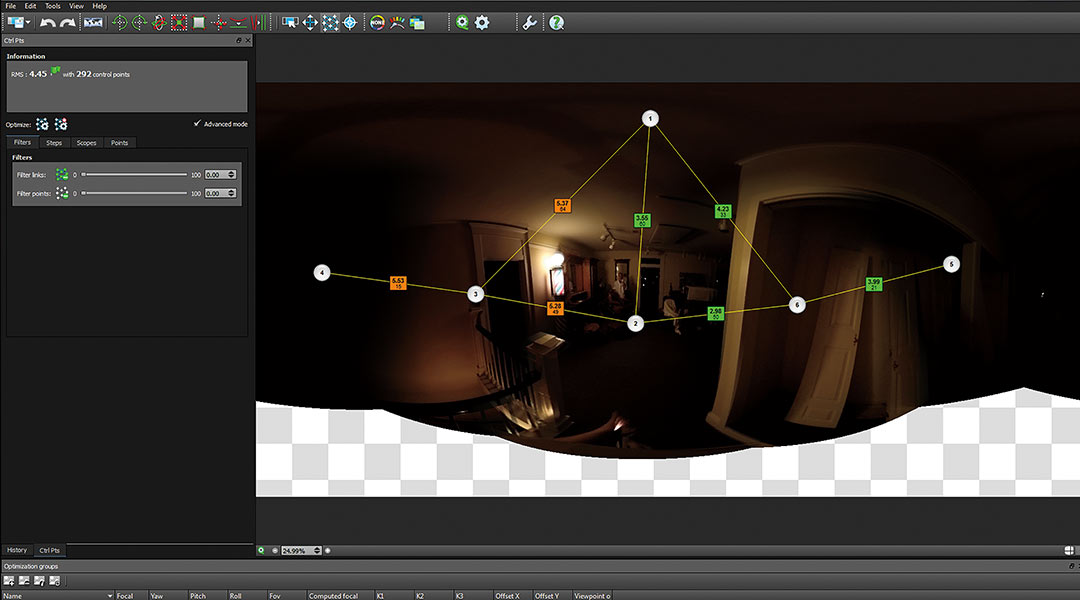
AutoPano Video Stitching Matrix
Aligning the 6 synchronized GoPro Hero cameras in AutoPano Video. Each color bounding box represents a quadrant stream, cross-referenced along overlapping control points to blend parallax seams.
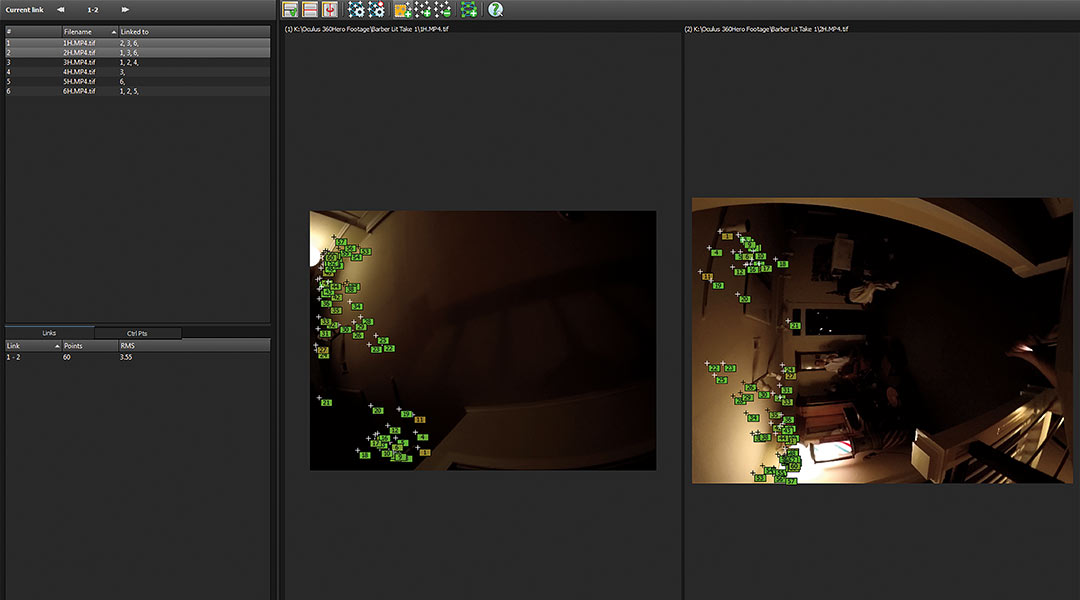
Fiducial Point Tracking
Synthesized motion points plotted across the cellar architecture. These points enabled optical stabilization to ensure the 6 camera sensors maintained a unified virtual nodal center.
The custom rig held 6 GoPro Hero cameras facing outward in a spherical geometry. Each camera recorded a high-bitrate stream at 60 frames per second with wide-angle lenses providing approximately 25% overlap between adjacent fields of view.
In post-production, the streams were frame-locked using acoustic clapper sync, followed by optical flow analysis in Kolor AutoPano Video. The resulting output was an ultra-high resolution equirectangular projection map ready for real-time projection onto an inverted virtual sphere inside the Oculus Rift DK2 environment.
Binaural Dummy-Head Recording & Sensory Headgear
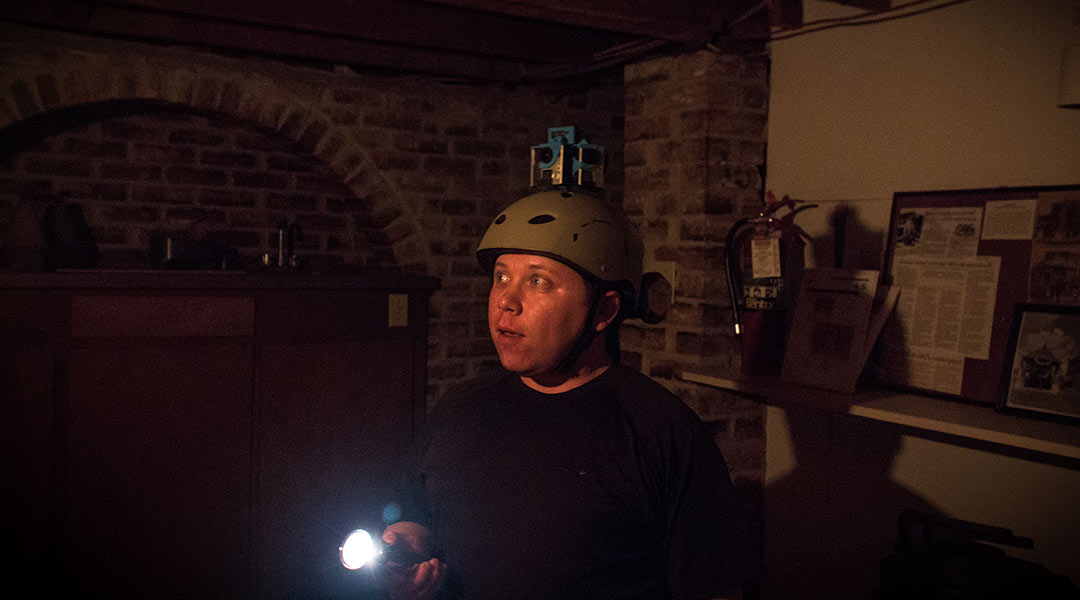
Telemetry Headset Apparatus
Barney fitted with the fabricated 360-degree telemetry sensory helmet, grounding the experimental film in tactile physical reality.
Visual immersion alone is fundamentally incomplete in virtual reality. If a viewer hears an unsettling creak in traditional stereo headphones, the brain perceives the sound as happening inside the head.
To achieve genuine psychoacoustic presence, Brendan fabricated a physical binaural dummy head microphone rig equipped with anatomical pinnae (outer ears) and matched condenser capsules. This preserved critical spatial cues:
- Interaural Time Difference (ITD): The microsecond delay between a sound reaching the left versus right ear.
- Interaural Level Difference (ILD): The acoustic shadow created by the physical skull.
- Pinna Filtering: Frequency spectral shaping indicating whether a sound originated above, below, or behind the head.
When the Victrola plays in the distance, you do not just hear it—you can pinpoint its exact coordinates in the cellar.
Stills, Calibration & Artifacts
Photographic evidence from the Fielder House Museum cellar shoot, AutoPano stitching, and sensory telemetry headgear fabrication.
AutoPano Video Seam Stitching
Aligning the 6 synchronized GoPro camera streams into an equirectangular 360° sphere, resolving parallax seams across the quadrant boundaries.
Camera Motion & Point Tracking
Tracking visual fiducial points throughout the stone basement corridor to stabilize moving camera trajectories and mitigate vestibular conflict.
Telemetry Headgear & Oculus Rift DK2
Barney equipped with the custom fabricated 360-degree VR sensory helmet, designed to couple tactile physical weight with virtual playback.
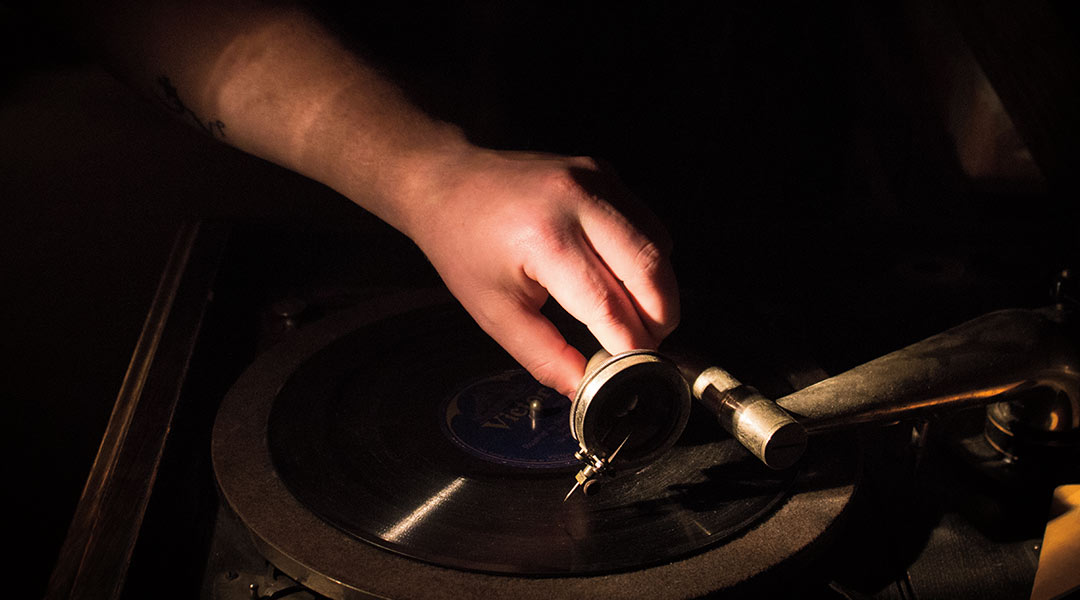
The Antique Victrola
The physical acoustic source inside the cellar, captured with the binaural microphone to position the haunting melodies in spatial 3D audio.
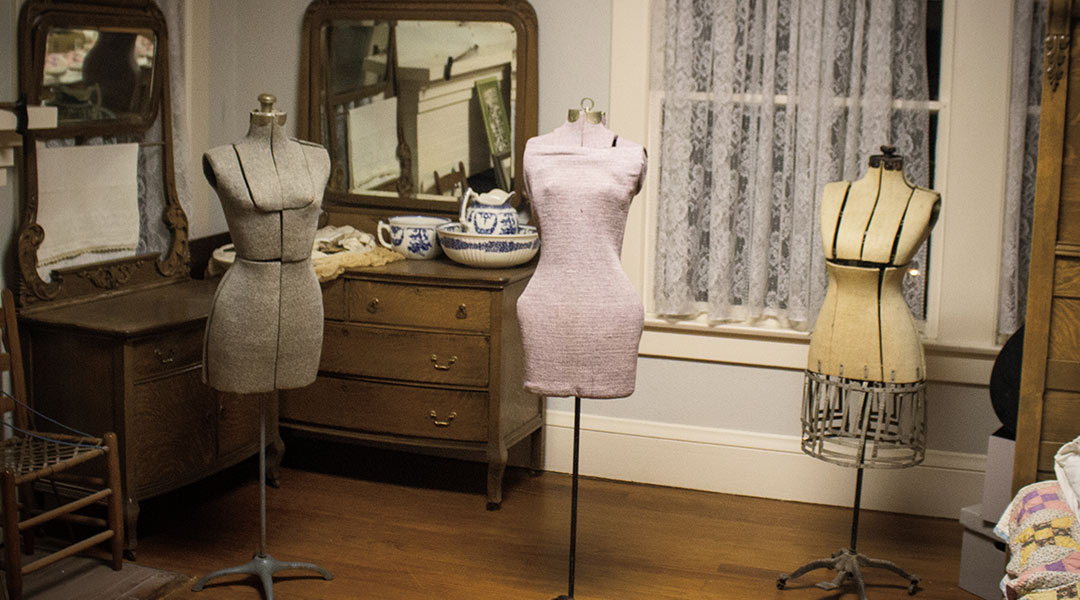
Museum Relics & Uncanny Mannequins
Original 1914 museum props draped in heavy vintage cloth to create a sensory labyrinth where stillness conceals impending terror.
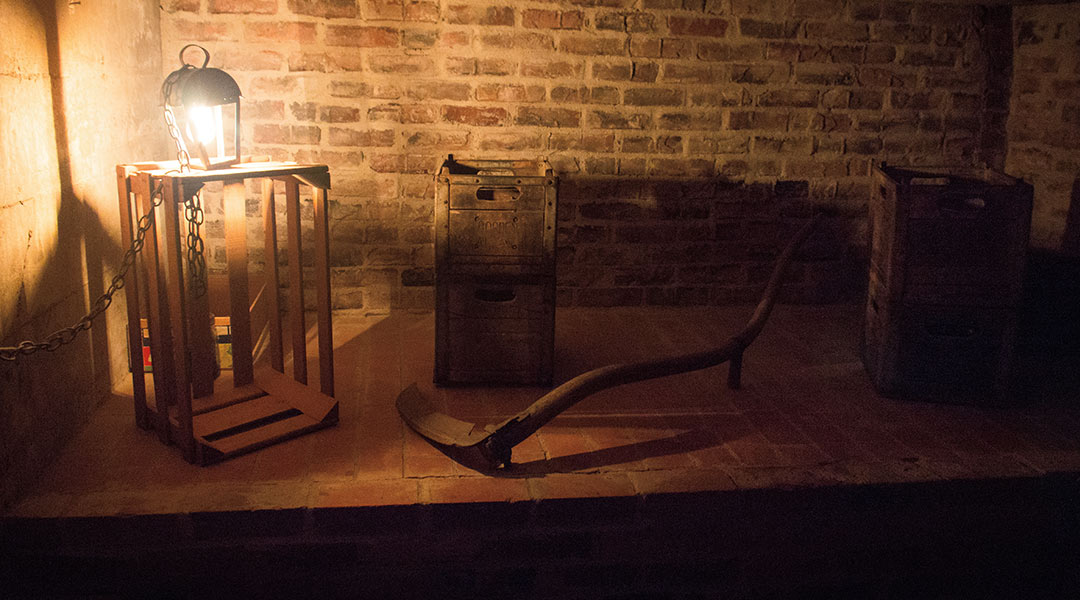
Subterranean Stone Masonry
The claustrophobic stone foundation of the Fielder House Museum, providing an acoustic and visual weight unattainable with CGI.
Technical & Rig Specifications
| Project Type | Experimental 360° Virtual Reality Cinema |
| Camera Array | Custom 6-Camera Synchronized GoPro Hero 360° Rig |
| Stitching Software | AutoPano Video & AutoPano Giga (Kolor) |
| Audio Technology | Custom Fabricated Binaural Dummy-Head Spatial Audio |
| Playback Target | Oculus Rift Development Kit 2 (DK2) / WebXR |
| Filming Location | Historic Fielder House Museum Basement (Built 1914, Arlington TX) |
| Soundtrack & Score | Antique Victrola Phonograph & Ambient Sub-bass Drones |
| Production Timeline | Conceptualized 2013 // Filmed 2014 // Preserved 2026 |
| Director / Creator | Brendan Feltrup-Exum |
| Production Company | Haywire Studios |
Step Back into the Cellar Simulation
Pivoting through the four walls of the historic Fielder House cellar will immerse you in the spatial dread of Interlink. You can also launch the 360° panoramic screening player directly from here.